
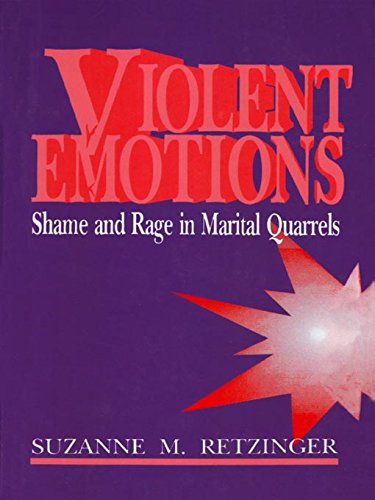
Violent Emotions: Shame and Rage in Marital Quarrels
Produktdetails
| Artikelnummer | 233374531 | Erscheinungsdatum | 2026/06/27 | Listenpreis | €27.06 | Modellnummer | 233374531 | ||
|---|---|---|---|---|---|---|---|---|---|
| Kategorie | |||||||||
In Violent Emotions, Retzinger explores the role of hidden alienation and shame as the source of repetitious cycles of conflict. Theories and research from large-scale conflict, marital disputes, and communication processes are reviewed and provide a background for a new integrative theory developed by the author. In testing her theory of prolonged conflict, Retzinger utilizes complex verbal and nonverbal coding schemes, identifies specific emotions within the context of marital disputes, and points out recurring patterns preceding the escalation of an argument. She provides exemplars of how this theory works through an intensive analysis of conflict exchange in four case studies and uses vivid descriptions to illustrate important points about communication in intimate relationships. Violent Emotions provides much needed data that will be useful for preventive and predictive measures in early marital problems and insight into the dynamics of family and other violence. It is an excellent volume for students and professionals in the fields of victimology, psychology, interpersonal communication, gender studies, and family studies. "Suzanne Retzinger has done such a fine job of presenting her theory and research. . . . I suspect that many researchers, teachers, and therapists will turn to the vivid descriptions and transcripts the author provides to illustrate important points about communication in intimate relationships." --from the Preface by Mary Anne Fitzpatrick University of Wisconsin, Madison (use the fitzpatrick quote for communication catalogs--she is the president of ICA) "Dr. Retzinger′s book is good news for both researchers and practitioners. It opens up a whole new field of emotions for understanding the sources of hidden conflict. . . . Psychotherapists, counselors, and mediators will find it particularly helpful, since the book shows in concrete detail how to detect and change underground conflicts. A gold mine of new ideas and techniques." --Thomas J. Scheff, University of California, Santa Barbara "It is a splendid work that goes to the heart of the possibilities for a world where conflict is dealt with more constructively and less violently. The integration of case study and theory is masterful." --Dr. John Braithwaite, The Australian National University, Australia "The author focuses on the crucial importance of shame in human bonding and the underlying dynamics of escalating conflict. The problem of escalating conflict and its relationship to unity is the foundation of this book." --Familiy Violence & Sexual Assault Bulletin "The author is well read and integrates with ease perspectives of conflict, communication, and bonding theories. . . . Researchers and practitioners concerned with marital and family interaction will be interested in this interdisciplinary approach to emotion." --Choice "A very impressive portrayal of the moment-by-moment flow of emotional meaning in disputes. Retzinger′s case studies add flesh and blood to the interactional skeleton of conflict and successfully reveal the subtle dynamics of marital quarrels that escape other methodologies. . . . Retzinger′s analysis of the dynamics of marital conflict make a lot of sense, both in the abstract and in concrete application. . . . Her findings are important and provocative. The book has the sensitivity and clarity that will make it useful reading for professionals or for bridge-level and graduate classes." --Contemporary Sociology "[Retzinger] offers the researcher in the field of family violence a potentially powerful explanatory tool to investigate why conflict is consistently found to be patterned in a specific sequence for each couple. Retzinger also offers the clinician concrete suggestions for interrupting the pattern and for guiding fighting couples to healthier interaction. I highly recommend this book to all working in the field of family violence." --The American Journal of Family Therapy "Retzinger′s book makes a [great]... Read more
Korrektur der Produktinformationen
Wenn Sie Unvollständigkeiten oder Fehler in den Produktinformationen auf dieser Seite bemerken, nutzen Sie bitte das Korrekturformular unten.
Korrekturanfrage