
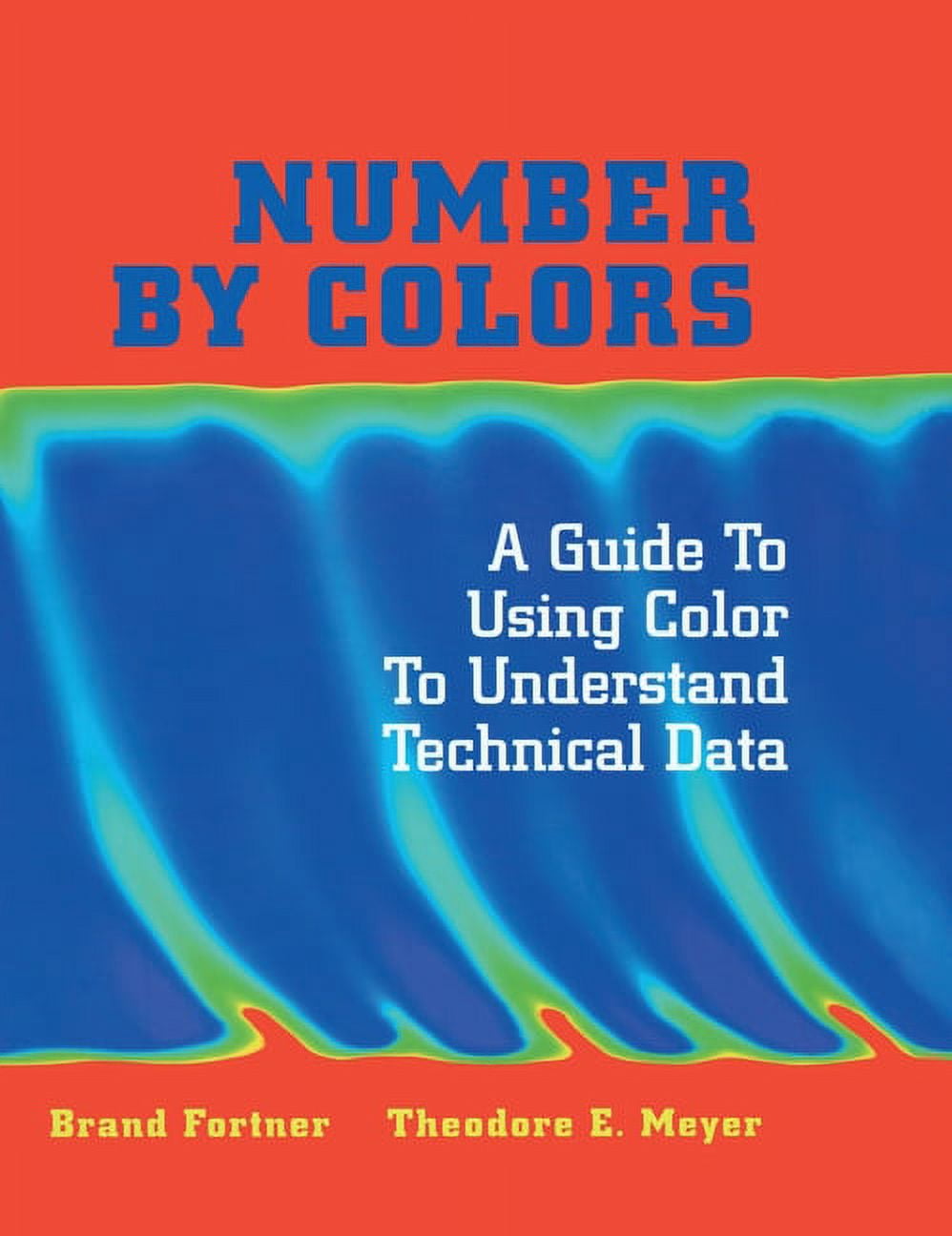
Number by Colors: A Guide to Using Color to Understand Technical Data, (Hardcover)
Produktdetails
| Artikelnummer | 238644901 | Erscheinungsdatum | 2026/07/11 | Listenpreis | €24.93 | Modellnummer | 238644901 | ||
|---|---|---|---|---|---|---|---|---|---|
| Kategorie | |||||||||
I: Color Physics, Physiology, Psychology.- 1 Spectral Analysis.- Introduction-Spectral Analysis.- Questions About Spectral Analysis.- Generating Waves.- Constructing a Harmonic Oscillator.- Sine Waves.- Waves in Space.- Sound Waves.- Analyzing Waves.- Power Spectra.- Calculating Power Spectra.- Light waves.- Electromagnetic Radiation.- Photons.- Light Definitions.- Summary-Spectral Analysis.- Responses to Questions About Spectral Analysis.- References.- 2 Eye, Ear, and Brain.- Introduction-Eye, Ear, and Brain.- Questions About Eye, Ear, and Brain.- The Ear-Sensing Sound.- The Physiology of the Ear.- The Five Dimensions of Sound.- The 3D + S +t Field.- The Spatial (X, Y) Dimensions.- The Depth (Z) Dimension.- The Sound Dimension.- The Time (t) Dimension.- The Ear-Summary.- The Eye-Sensing Light.- Sensing Light.- The Physiology of the Eye.- The Parts of the Eye.- The Photosensors: Rods and Cones.- The Visual Pathway and the Lateral Geniculate Nucleus.- The Five Dimensions of Light.- The 3D + C + t Field.- The Spatial (X, Y) Dimensions.- The Depth (Z) Dimension.- The Time (t) Dimension.- The Light Dimension.- Summary-The Eye and the Brain.- Responses to Questions About Eye, Ear, and Brain.- References.- 3 Light Spectra to RGB.- Introduction-Light Spectra to RGB.- Questions About Light Spectra to RGB.- Sensing the Light Spectra.- Sensing Reflected Light.- Color Constancy.- Colorblindness.- Summary-Light Spectra to RGB.- Responses to Questions About Light Spectra to RGB.- References.- 4 Hue, Saturation, Intensity.- Introduction-Hue, Saturation, Intensity.- Questions About Hue, Saturation, Intensity.- Dueling Theories of Color Perception.- The Young-Helmholtz Theory.- The Herring Theory.- The Modern Synthesis.- Defining Hue, Saturation, Intensity.- Intensity.- Intensity, Brightness, Reflectivity.- Perception Versus Physics.- Old Movies.- Hue.- Saturation.- A Laser and Floodlight.- Non-Rainbow Colors.- A Missing Pure Hue.- Brown.- Color Temperature.- When RGB, When HSI?.- Producing Colors in RGB.- Describing Colors in HSI.- Summary-Defining Colors.- Responses to Questions About Hue, Saturation, Intensity.- References.- II: Color Technology.- 5 Defining Colors-The CIE Color Diagram.- Introduction-The CIE Color Diagram.- Questions for Defining Colors-The CIE Color Diagram.- From Three Dimensions to Two.- The Color Cube.- The Color Circle and Color Triangle.- Selecting the Primary Colors.- Response Curves for Color Cube.- Light Spectra for Color Cube.- The CIE 1931 Diagram.- Why X, Y, Z?.- CIE 1976.- Describing and Mixing Colors on the CIE.- Describing Colors on the CIE.- Mixing Colors on the CIE.- Primary Colors on the CIE.- More Adventures on the CIE.- White Points.- Colorblindness.- What about Intensity?.- What the CIE Cannot Do.- Reproducing the CIE.- Summary.- Responses to Questions for the CIE Color Diagram.- References.- 6 Defining Colors-Color Models.- Introduction-Defining Colors-Color Models.- Questions for Color Models.- Additive Versus Subtractive Color Models.- Two Greens Make a Green.- Two Greens Make a Black.- Cyan and Yellow Make Green.- Making Pink.- Further Adventures of Subtractive Color.- Complementary Colors and the Color Circle.- Why White and Red make Pink.- Subtractive Colors on the CIE.- Subtractive Primaries.- The Color Models.- The RGB Color Model.- The CMY and CMYK Color Models.- The RYB Color Model.- The YIQ Color Model.- The HSI, HSV, HSB, and HLS Color Models.- Summary.- Responses to Questions.- References.- 7 Reproducing Colors-Fundamentals.- Introduction-Reproducing Colors.- Questions About Reproducing Colors-Fundamentals.- Pixels.- Pixels and Dots per Inch.- Rectangular Pixels.- Resolutions.- Continuous Versus Discrete.- Spatial and Intensity Resolutions.- Gamma Correction.- The Need for Gamma Correction.- Other Uses for Gamma Correction.- Halftones.- What is a Halftone?.- Making a Halftone.- Lines per Inch and Dots per Inch.- Digital Halftones.- Making Digital Halftones.- How Many Intensities?.- Cluste
- Number by Colors: A Guide to Using Color to Understand Technical Data, (Hardcover)
- Author: Springer
- ISBN: 9780387946856
- Format: Hardcover
- Publication Date: 1996-10-30
- Page Count: 388
| Book format | Hardcover |
|---|---|
| Fiction/nonfiction | Non-Fiction |
| Genre | Textbooks |
| Publication date | October, 1996 |
| Pages | 388 |
| Subgenre | Physics |
| Series title | No Series |
| Number in series | 0 |
| Edition | 1 |
| Publisher | Springer |
| Original languages | English |
| Language | English |
| Edu focus | Physics, Technology |
| Is collectible | N |
| Binding type | Case Binding |
| Retail packaging | Single Piece |
| Assembled product height | 9.46 in |
| Assembled product weight | 2.14 lb |
| Bisac subject heading | Science |
Korrektur der Produktinformationen
Wenn Sie Unvollständigkeiten oder Fehler in den Produktinformationen auf dieser Seite bemerken, nutzen Sie bitte das Korrekturformular unten.
KorrekturanfrageKundenbewertungen
Für dieses Produkt liegen derzeit keine schriftlichen Bewertungen vor.